
In my last post, I alluded to another upgrade that goes hand in hand with the Distillation Tank Filter (DTF): media filter vessels. The DTF is great at distilling out heavy impurities, but what if the impurity is in the vapor stream?
Not Just for Color
When most people think of a media filter vessel, they think of a Color Remediation Chromatography (CRC) vessel. CRC vessels use polar adsorbent media to attract the polar molecules in a cannabinoid and solvent slurry. Those molecules can darken the end product and make it less attractive to the consumer.
But color is only part of the story. There are lots of different media on the market, and they can do far more than remediate color.
The Moisture Problem
Moisture can seriously hinder an operation. It can enter the system in a medley of ways, including through the supply storage tanks, but however it gets in, it shouldn't be there.
Distillation can remove some of it, but some moisture evaporates along with the solvent and ends up in the vapor stream. From there, it causes trouble in several places:
- Heat Exchangers: Moisture can create ice blockages that stop solvent from moving through a heat exchanger.
- Operating Tanks: I've seen moisture accumulate enough to block the dip tube and keep liquid solvent from getting out.
- Your Concentrate: Moisture can get trapped in the finished product and cause the dreaded "sizzle" when a consumer dabs it.
Any one of these costs you time, product quality, or both.

Two Media Vessel Upgrades for Moisture
I helped design two media vessels that attack moisture at different points in the recovery process.
Vapor Moisture Filter (VMF)
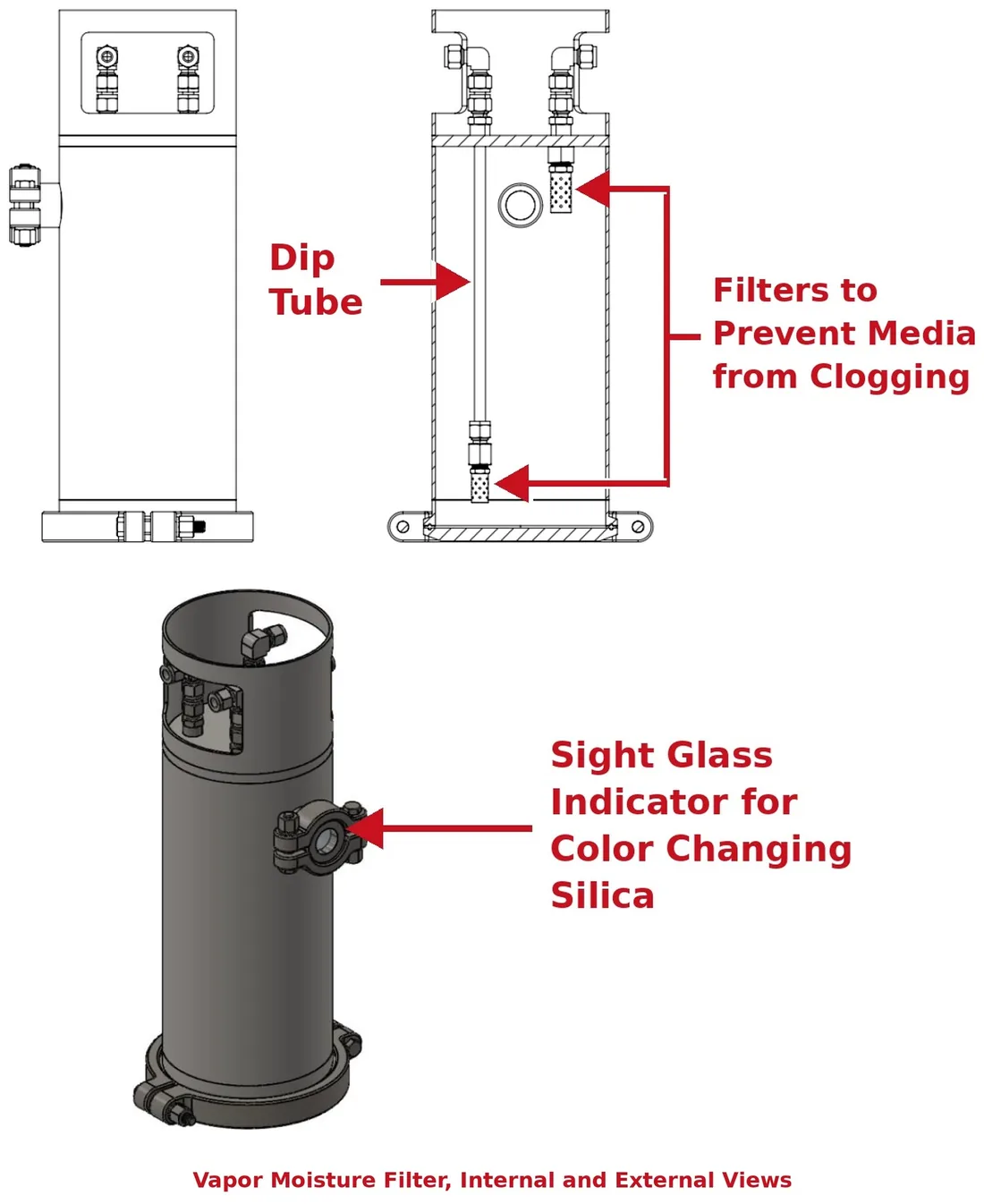
The VMF cleans the vapor stream from evaporated solvent. A dip tube forces the vapor to the bottom of the media vessel, so it has to travel up through a bed of desiccant that removes moisture. This happens before the vapor reaches the recovery pump on an active recovery system, or the chilled heat exchangers on a passive recovery system.
The VMF also has a sight glass at the top of the vessel that can be filled with color-changing silica. The silica indicates moisture, so the operator can see at a glance when the media needs to be changed out.
Recovery Pump Moisture Filter (RPMF)
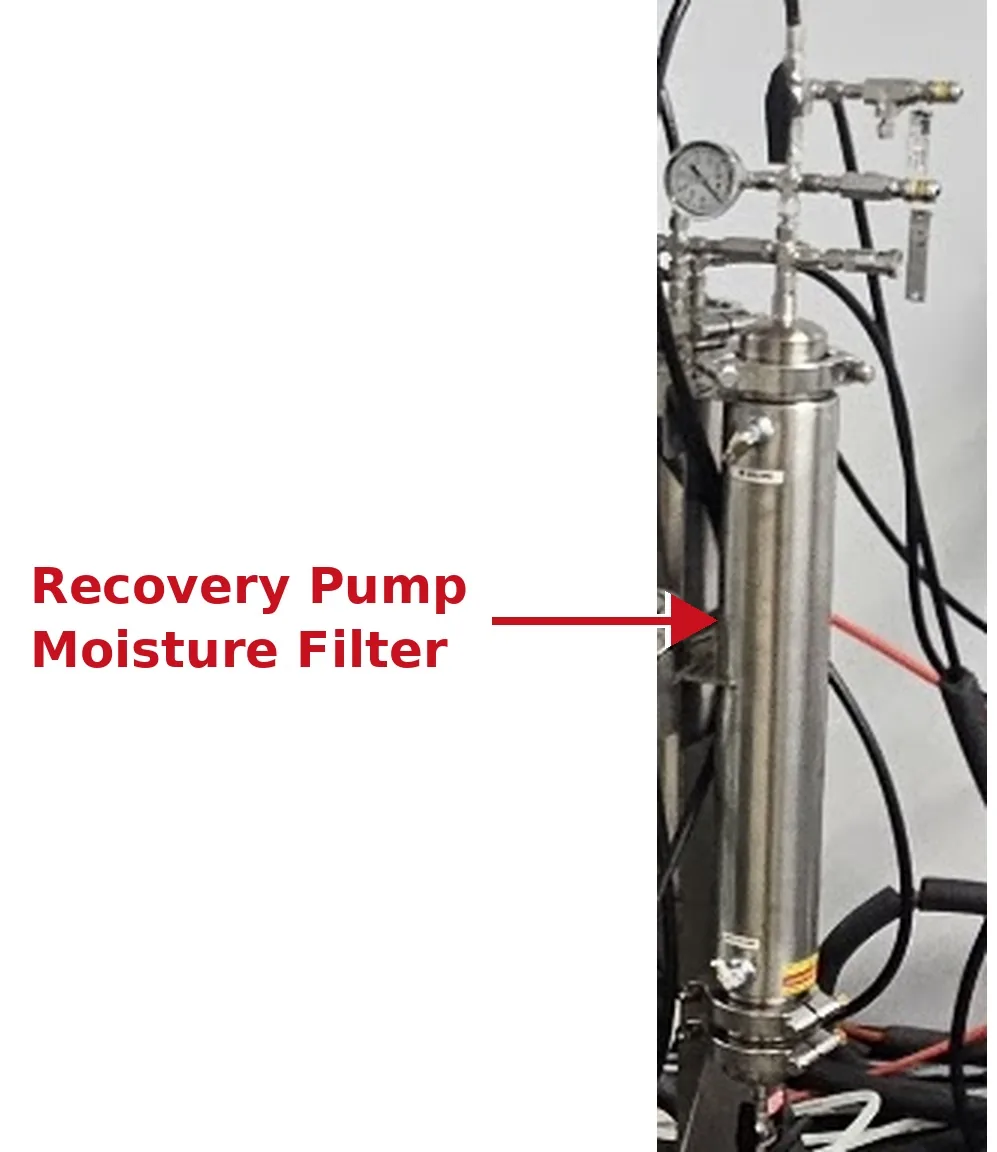
The RPMF sits on the discharge side of a recovery pump. Once the vapors have been converted back into a liquid, they pass through a bed of desiccant to remove moisture before reaching the chilled heat exchangers. Depending on the system, this vessel can be heated to keep moisture from turning to ice inside the RPMF and creating a blockage.
The RPMF has an added bonus: it can help catch residues generated by the recovery pump. Recovery pumps get very hot while recondensing the solvent, and some clients have seen a black dust show up in their solvent tank that we assumed was carbon. My theory is that low-level volatile organic compounds (VOCs) that evaporate with the solvent can combust in the pump and leave carbon dust as a byproduct. The RPMF can help keep those residues from going back into the solvent tank.
Heat Your CRC Vessel
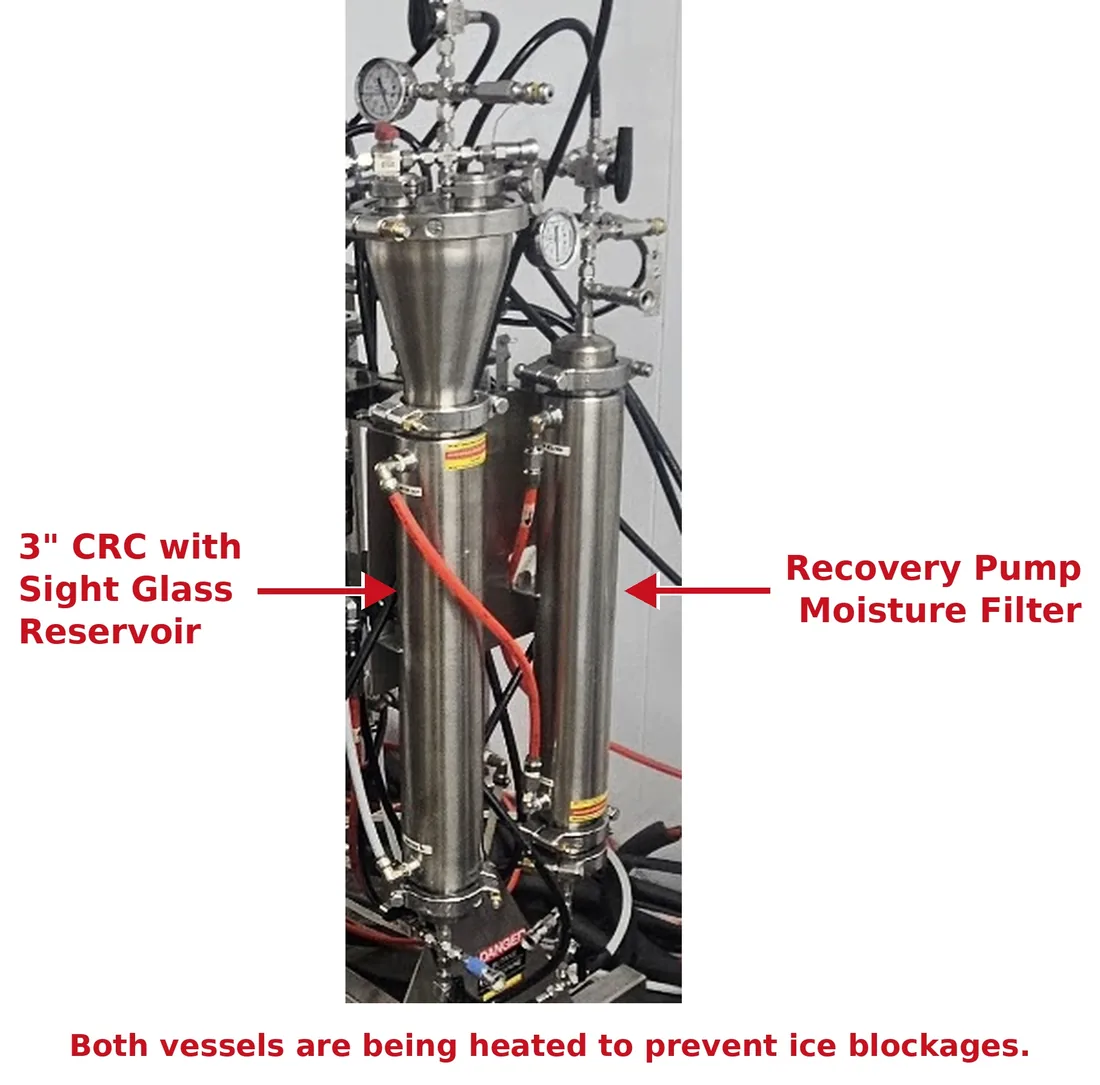
Speaking of ice blockages in media vessels, I always recommend heating the CRC vessel. During an extraction, you're much more likely to pick up moisture than you are from the source tank. Here's why:
- Condensation in Chilled Material Vessels: Chilled vessels pull moisture from the atmosphere, and it condenses on the internal side walls. The more humid your environment and the colder you chill the vessel, the more moisture accumulates. When a sock is inserted, it can get knocked to the bottom and make its way into the extracted slurry.
- Fresh Frozen Material: It can contain more than 80% moisture. If it defrosts, that water can be pushed into the slurry as well.
That's why the goal of a CRC vessel isn't always just color remediation. Removing moisture can be just as important, and the dreaded "sizzle" is something to avoid at all costs.
Heating the vessel prevents moisture from creating an ice blockage and makes the media more effective at removing impurities. I'm not talking about running the heater at 100°F. I recommend running it at 5 to 10°F above room temperature.
Avoid the "Media Bomb"
There's a safety reason to heat the vessel too. When solvent starts to slow and pool because of an ice blockage, it cools down and reduces the pressure in the vessel, sometimes down to zero PSIG.
When I ran tech support for ETS, I had multiple clients who saw their gauges read zero and thought the run had finished. They went to open the media vessel, and the rush of warm air instantly vaporized the cold solvent inside and pressurized it. We called this a media bomb. It is very dangerous and should be avoided. Heating the vessel helps make sure it doesn't happen.
What Else Can Media Do for You?
Media can help filter out all sorts of things, not just color and moisture. I've worked with clients who use media vessels to remediate heavy metals, pesticides, and other contaminants.
Different media target different contaminants, so the right choice depends on what you need to remove. If you have a contaminant problem in your process, a media vessel may be part of the answer.
The Takeaway
The DTF protects your system from heavy contaminants. Media vessels handle what the DTF can't reach, including moisture in the vapor stream. With the VMF and RPMF, you can catch moisture before it freezes up your heat exchangers or blocks your dip tubes. By heating your media vessel, you get better filtration, fewer blockages, and safer operation.
If your CRC is running slower than you would like, tune in to my next post to see if a holding vessel can help your operation.
Let Me Help You Get It Done
I can provide these upgrades, help install them, and train your operators to use them. Contact me at [email protected], or see our full equipment services.
Fighting moisture or ice blockages?
Dustin can supply, install, and train your operators.